Emerald
Emerald is the one stone whose imperfections are welcomed. The tiny garden of lines inside, called the jardin, is its fingerprint, and no two are alike.
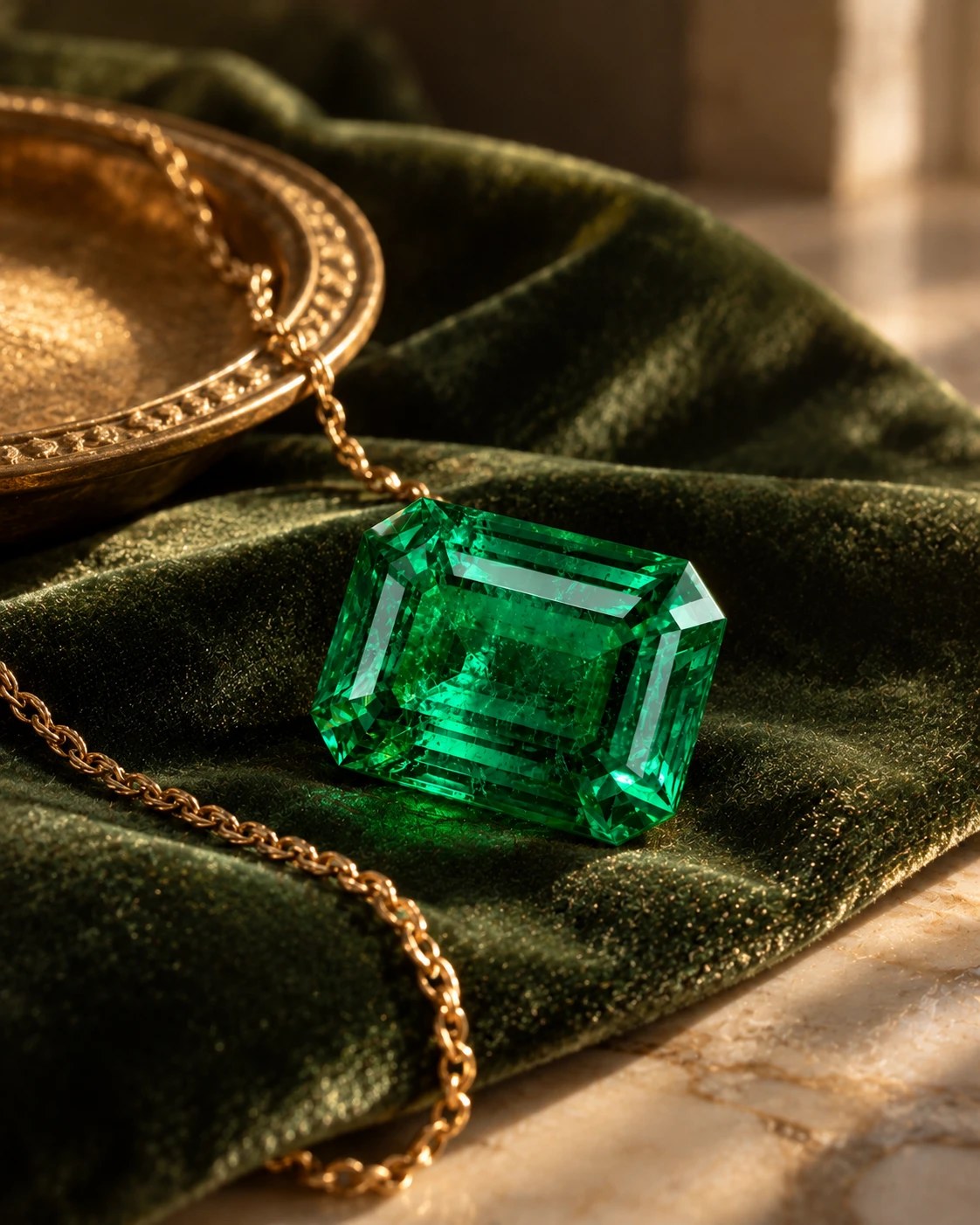
Beryl, coloured by chromium and vanadium.
Emerald is the green variety of beryl. Its colour is among the richest of any gem, and a fine one glows with a bluish-green that no other stone can imitate. The same mineral without the colour is called colourless beryl and is worth far less.
Because nearly every emerald is formed with fine cracks, almost all are treated with a clear oil or resin to make them less visible. This is long-standing practice. What matters is how much, and that it is disclosed on a laboratory report.
| Species | Beryl |
|---|---|
| Composition | Beryllium aluminium silicate with chromium and vanadium |
| Colour sought | Vivid, slightly bluish green, neither pale nor too dark |
| Principal origins | Colombia (Muzo, Chivor, Coscuez), Zambia, Brazil, Afghanistan |
| Treatments | Clarity enhancement with oil or resin is the norm. Laboratories grade it from none to significant, and we show none to minor only |
Four things we check before an emerald is shown.
Colour
Saturated green with a touch of blue, evenly spread, with the stone staying lively and clear in daylight.
The jardin
Inclusions are expected and acceptable. We avoid cracks that reach the surface or that cloud the whole stone.
Treatment grade
We read the laboratory’s treatment grade and show only stones graded none to minor.
Cut
An emerald cut protects the corners of a brittle stone. We look for a setting-ready shape without sharp exposed corners.
Emerald and Mercury.
In the classical tradition, emerald is the stone of Mercury (Budh) and is associated with speech, learning, intellect and trade. It is traditionally set in gold and worn on the little finger on a Wednesday.
Which weight and which setting, and whether emerald is suited to you at all, are matters for your astrologer. We prepare the shortlist from that advice.
Care. Emerald is brittle at the edges and may be oil-treated, so avoid ultrasonic and steam cleaners. Wipe it with a soft damp cloth, take it off for heavy work, and have it checked now and then, since an old oil treatment may need renewing.
Asked about emerald.
Why does a fine emerald have inclusions?
Emeralds form under pressure and almost always carry fine fractures and tiny crystals. A completely clean emerald is rare, and a stone with no inclusions at all deserves a closer look.
Is oiling an emerald a problem?
No, it is the accepted norm, provided it is disclosed. We read the laboratory’s grade and show only stones with none to minor enhancement.
Can an emerald be worn every day?
With care, yes. Set it in a protective mount, and take it off for heavy work.
See the emerald in person.
Stones are shown on a video call first, then in person at a quiet place near you, with the laboratory report beside the stone.
Book a Meeting