Cat’s Eye
Cat’s eye is a chrysoberyl cut as a smooth dome, so that one sharp band of light seems to float across its surface. It is the stone of Ketu, the south node.
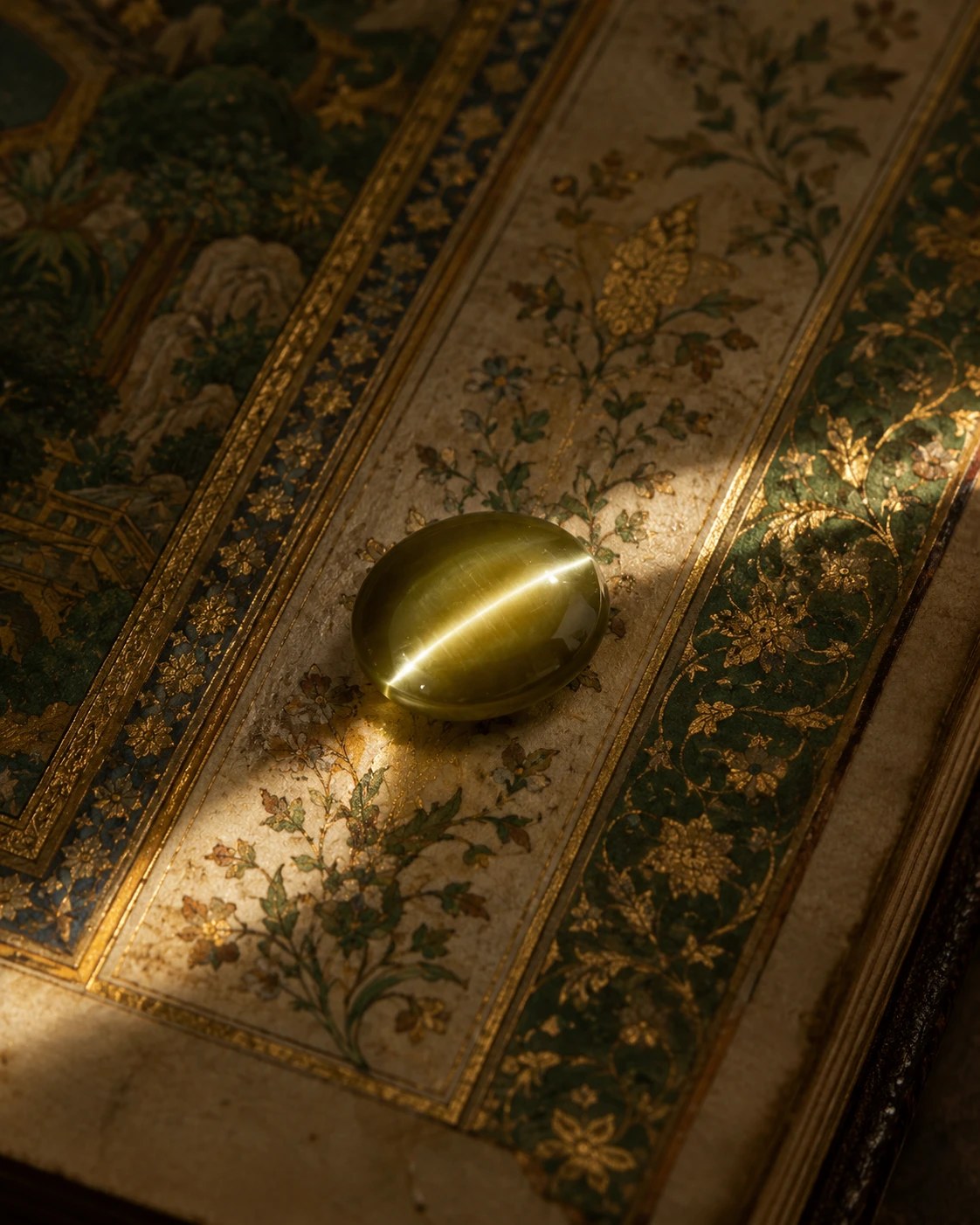
Chrysoberyl, with a line of light.
Cat’s eye is the cabochon-cut variety of chrysoberyl. Millions of microscopic needle-like inclusions run in one direction and reflect light into a single bright band, an effect called chatoyancy. As the stone is turned, the band moves, and in a fine stone it seems to open and close like an eye.
A fine cat’s eye shows a sharp, straight, centred line and a honey-to-green body. Quartz cat’s eye and other imitations exist, so a laboratory report names the species as chrysoberyl.
| Species | Chrysoberyl, chatoyant variety |
|---|---|
| Composition | Beryllium aluminium oxide |
| Colour sought | Honey, yellow-green or apple green, with a bright silvery-white line |
| Principal origins | Sri Lanka, Brazil, India, Madagascar |
| Treatments | Usually untreated. We state anything done to the stone |
Four things we check before a cat’s eye is shown.
The eye
A fine eye is straight, sharp, centred and bright, with a clean sweep and no break across the dome.
Milk and honey
The line should split the stone into two tones, a lighter milk and a deeper honey, when lit from one side.
Body
A clear, even body of honey or green, not cloudy or dull.
Species
We confirm on a laboratory report that the stone is chrysoberyl and not quartz or glass.
Cat’s Eye and Ketu.
In the classical tradition, cat’s eye (lehsunia) is the stone of Ketu, the south node, and is associated with detachment, insight and protection. It is traditionally set in silver or an alloy of five metals (panchdhatu) and worn on the middle finger.
Traditions differ about the best day to begin wearing it, so we leave that to your astrologer, together with the question of whether it suits your chart.
Care. Cat’s eye is hard and durable and cleans well in warm, soapy water. As a cabochon, its dome can show scratches from harder stones, so store it apart from diamonds and sapphires.
Asked about cat’s eye.
What makes the eye move?
Fine needle-like inclusions all running one way reflect light into a single band that shifts as the stone is turned. The effect is called chatoyancy.
How do I tell a real cat’s eye from a quartz one?
A laboratory report names the species. Chrysoberyl is also noticeably harder, and its eye is sharper than that of quartz.
Should the stone be a certain size?
Your astrologer advises on weight. We then show certified stones at that weight.
See the cat’s eye in person.
Stones are shown on a video call first, then in person at a quiet place near you, with the laboratory report beside the stone.
Book a Meeting