Pearl
Pearl is the only gem grown by a living creature, and the only one that is finished the moment it is found. Nothing is cut and nothing is faceted: what you see is what the sea made.
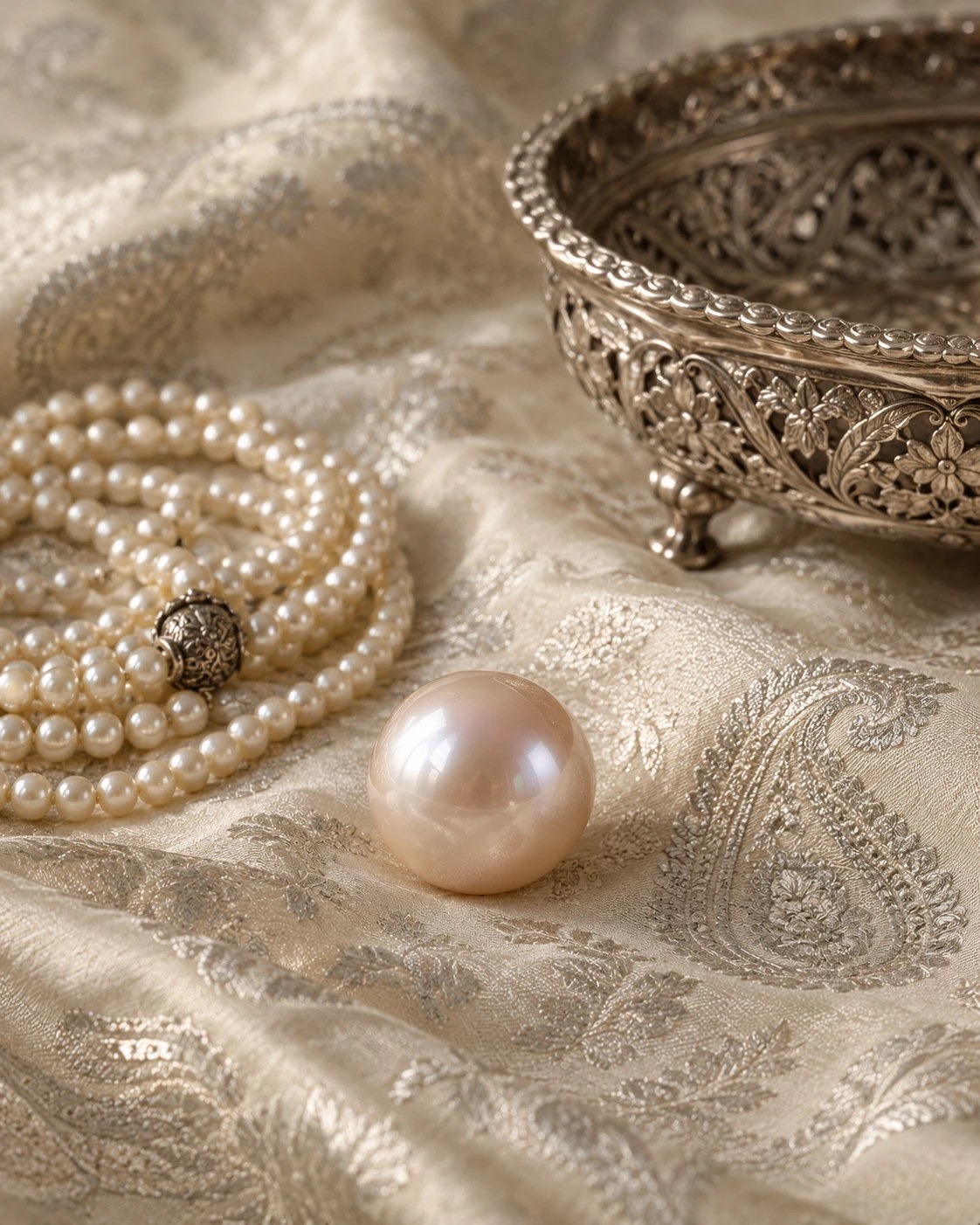
Nacre, laid down layer by layer.
A pearl forms when a mollusc coats an irritant in thin layers of nacre. The soft glow that results is called lustre, and it is the single best sign of a good pearl: a fine one shows a sharp, bright reflection and a deep, even glow, while a poor one looks chalky.
Most pearls on the market today are cultured, which means a person places the nucleus and the mollusc does the rest. Natural pearls, formed with no such help, are far rarer and are identified by laboratory testing.
| Species | Organic gem, calcium carbonate in layers of nacre |
|---|---|
| Colour sought | Cream, white or rose overtones with a bright, deep lustre |
| Principal origins | Persian Gulf (historic natural pearls), South Sea, Tahiti, Japan, China |
| Treatments | Bleaching, tinting and surface polishing are common in cultured pearls and must be disclosed |
Four things we check before a pearl is shown.
Lustre
The first thing we judge. A fine pearl shows a bright, sharp reflection of the room, not a dull milky haze.
Surface
Tiny natural marks are expected. We avoid deep pits, cracks and flaking nacre.
Shape and size
A round pearl is rarest. A well-formed drop or oval is equally welcome when the lustre is fine.
Natural or cultured
We state plainly which a pearl is. A natural pearl is confirmed only by laboratory testing, and we show that report.
Pearl and The Moon.
In the classical tradition, pearl is the stone of the Moon (Chandra) and is associated with calm, intuition, emotional balance and a settled mind. It is traditionally set in silver and worn on the little finger, with some traditions favouring the ring finger, on a Monday.
Practices differ between lineages, so we leave the finger, metal and weight to the astrologer you trust.
Care. Pearl is soft and organic. Put it on after perfume, hairspray and make-up, wipe it with a soft damp cloth after wearing, and store it on its own in soft cloth, never sealed in plastic. Keep it away from acids and heat.
Asked about pearl.
Are your pearls natural or cultured?
We state which, on the stone and on the report. A natural pearl is far rarer and is confirmed by laboratory testing.
Does a pearl fade or yellow with age?
A pearl is a living material, so it benefits from wear and gentle care. Perfume, sweat and dryness are what dull it, and wiping it after use largely prevents that.
Can I bring my own pearl for the chart check?
Yes. Bring it to our meeting and we will tell you plainly what it is.
See the pearl in person.
Stones are shown on a video call first, then in person at a quiet place near you, with the laboratory report beside the stone.
Book a Meeting