Red Coral
Coral is neither stone nor plant. It is the skeleton of a tiny sea animal, grown over decades and polished until the colour of the deep sea glows through.
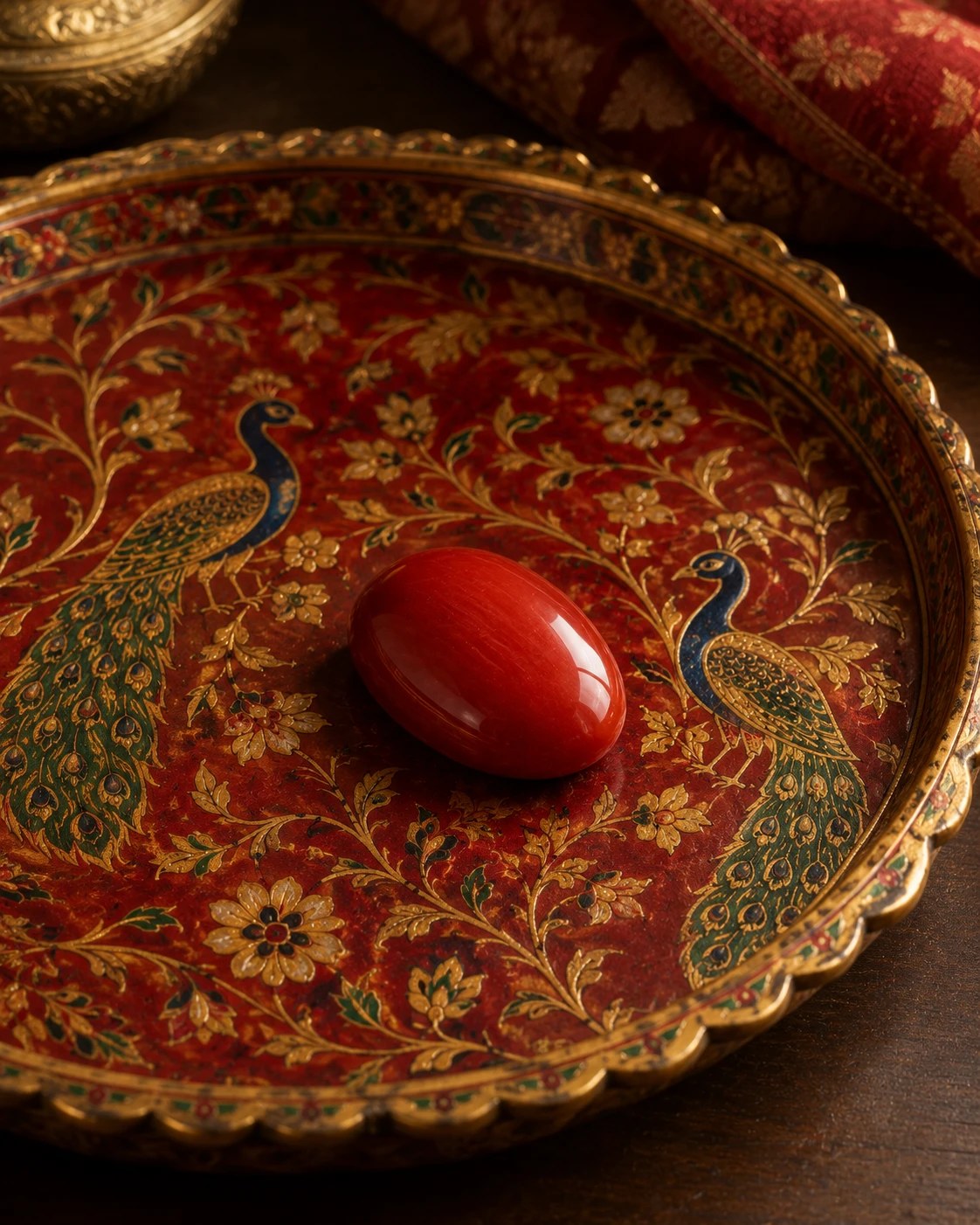
A red that grew in the sea.
Precious red coral comes from the Mediterranean and from the waters off Japan and Taiwan. It is cut as a cabochon or a bead, never faceted, because its beauty is in the even, glossy colour.
Coral is also one of the most commonly dyed gems. A deep, uniform colour that looks too perfect should always be questioned, which is why we show natural-colour stones only and explain how to tell them apart.
| Species | Organic gem, calcium carbonate |
|---|---|
| Colour sought | Deep, even red to oxblood with a smooth, glossy surface |
| Principal origins | Mediterranean, Japan, Taiwan |
| Treatments | Dyeing and bleaching are widespread in the trade. We show natural colour only and state any polishing or stabilising |
Four things we check before a red coral is shown.
Natural colour
Natural coral shows faint growth lines in its colour. A flat, impossibly even red is a warning sign.
Surface
We avoid pits, white patches and cracks, and look for a smooth, glossy finish.
Cut
A well-polished cabochon with a clean dome shows the colour best.
Documentation
Coral trade is regulated in many places, so we keep records showing that our stock was acquired legally.
Red Coral and Mars.
In the classical tradition, red coral is the stone of Mars (Mangal) and is associated with courage, energy, drive and protection. It is traditionally set in gold or copper and worn on the ring finger on a Tuesday.
Because Mars is regarded as a strong planet, traditions advise taking particular care before wearing coral. We rely on your astrologer’s chart reading, not on our own advice.
Care. Coral is soft and reacts to acids, so keep it away from perfume, vinegar and cleaning products. Wipe it with a soft damp cloth and store it wrapped, apart from harder stones that could scratch it.
Asked about red coral.
How can I tell natural coral from dyed coral?
Natural coral shows fine growth lines and slight variation in colour. A laboratory or a trained eye can confirm it, and we show you how when we meet.
Is it legal to buy and wear coral?
We keep documentation that our stock was legally acquired. Rules vary by country, so we also advise you on moving a stone across borders.
Which red is best?
A deep, even red or oxblood with a glossy surface. Pale or orange tones are less sought after.
See the red coral in person.
Stones are shown on a video call first, then in person at a quiet place near you, with the laboratory report beside the stone.
Book a Meeting