Ruby
Ruby is the king of coloured stones. In Sanskrit it is ratnaraj, the king of gems, and it has been worn by rulers for as long as there have been rulers to wear it.
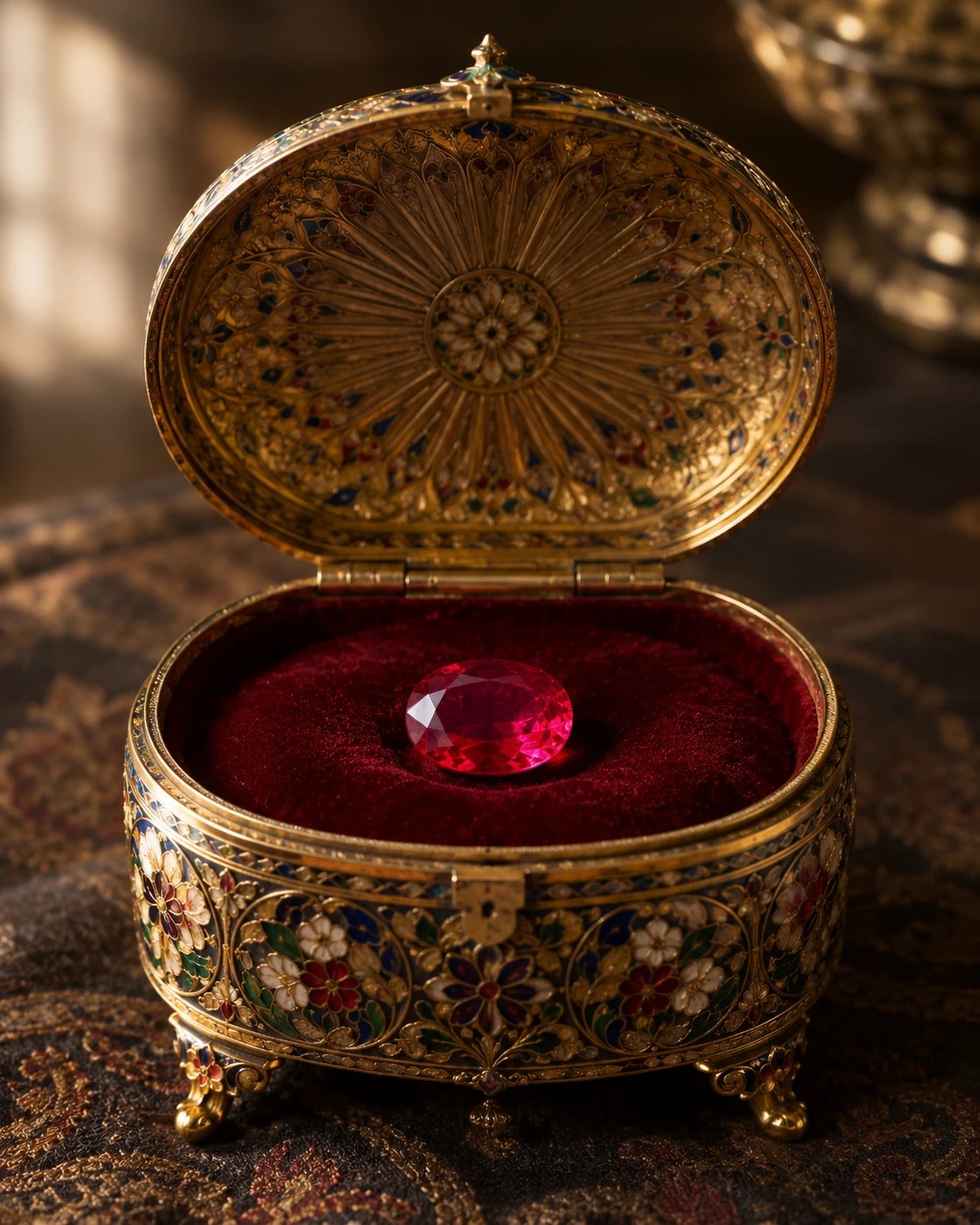
Corundum, coloured by chromium.
Ruby is the red variety of corundum, the same mineral as sapphire. A trace of chromium gives it its colour and, under daylight, a faint inner glow of its own. After diamond it is one of the hardest natural gemstones, which is why a fine ruby survives centuries of wear.
The finest colour is a vivid, saturated red with a hint of blue, known in the trade as “pigeon’s blood”. Brownish or orange-leaning reds, and pale pinks, are different stones with different prices.
| Species | Corundum |
|---|---|
| Composition | Aluminium oxide with chromium |
| Colour sought | Vivid, evenly saturated red with a slight blue undertone |
| Principal origins | Mogok (Myanmar), Mozambique, Thailand, Sri Lanka, Madagascar |
| Treatments | Heat treatment is common and accepted when disclosed. Unheated rubies of fine quality are rare and carry a premium |
Four things we check before a ruby is shown.
Colour
An even, glowing red with no brown or orange shadow. Colour is the largest part of a ruby’s value, and we look at it under all three of our lights.
Clarity
Fine natural silk is part of a ruby and is no flaw. We avoid fractures that reach the surface, and any stone whose clarity has been improved with glass or other fillers.
Cut
A good cut makes the colour lie evenly across the stone, with no dead window in the centre. We prefer a well-proportioned stone over one cut for the heaviest weight.
Origin and treatment
Every ruby we show carries an independent laboratory report stating its species, treatment and, where the evidence allows, its origin.
Ruby and The Sun.
In the classical Indian tradition, ruby is the stone of the Sun (Surya) and is associated with vitality, authority, confidence and standing. It is traditionally set in gold and worn on the ring finger on a Sunday morning.
As with every stone on this site, whether ruby suits you and what weight to wear are questions for your chart. We shortlist stones against what your astrologer advises, and do not suggest a stone from the shelf.
Care. Ruby is hard and durable and cleans well in warm, soapy water with a soft brush. Keep it apart from other stones in storage, and have a stone with any filling or heavy fracture checked before ultrasonic cleaning.
Asked about ruby.
Is a heat-treated ruby acceptable?
Heating is the long-standing, widely accepted way of improving ruby colour and is permanent. What matters is that it is disclosed. We state the treatment on every stone and show unheated stones where we have them.
What does “pigeon’s blood” actually mean?
It is a trade term for the finest red, vivid and slightly warm with a hint of blue. It is a description of colour, not a guarantee of origin, and a laboratory report is what states origin.
How heavy should a ruby be?
That is decided by your astrologer, not by us. We will show you the certified stones available at the weight advised.
See the ruby in person.
Stones are shown on a video call first, then in person at a quiet place near you, with the laboratory report beside the stone.
Book a Meeting